Board Games

Had a pleasant evening with the Cisra folks playing Magical Athlete, Between Two Cities, and 7 Wonders (first time playing with the Leaders expansion).

I liked the idea of Magical Athlete more than the actual play experience. In theory it’s quick so when some players are comboing off. It doesn’t last too long, but in practice it was “look at those people having fun over there”.

One of my difficulties with the original Imperium Classics and Imperium Legends was that the bot turns felt a bit like that; sometimes the bot would have a great turn followed by me doing something unspectacular and saying go. Despite that, I’d heard that Star Trek: Captain’s Chair was really good and had improved the Imperium formula, so I couldn’t resist when I saw a single copy in stock at the Melbourne Games Chain (one of the best board game stores there is).

And I’ve got it to the table, but as it often the case when I’m learning a new game, it’s been two weeks and I’ve yet to take my first turn.

I had a much easier time getting into Corrosion, it was a breezy Euro along the lines of Black Forest, Blackout: Hong Kong, Nusfjord etc.

Published it!

Much to my relief, I got some continuous time & energy and got Episode 7 of Valorant for Dinosaurs together and published it.

It’s interesting to watch my executive dysfunction and the kind of things that can push past it. In this case it was the enthusiasm I’d gotten from making Episode 8. I hadn’t planned to make that particular episode, but it solves some anxieties that were draining the energy out of doing the regular series.

Enough so that here I am, early on a Saturday morning, plotting out Episode 8 with the idea of publishing it this weekend…

Valorant for Dinosaurs

I’ve been struggling to continue my youtube series Valorant for Dinosaurs. The last episode I published was over a year ago, and I’ve had an episode sitting on my laptop for a very long time, with the full narration but missing the video examples.

And of course the reason is my ADHD executive dysfunction. It’s very obvious to me now, but for most of my life I’ve known that after a while with any project it’s really difficult for me to continue with it. I just don’t want to, and it’s not for any particularly good reason – I just can’t bring myself to do it.

Now that I have medications it’s somewhat easier (though on weekends when I give myself a rest from the meds it is still difficult). It does help to articulate some of the sticking points:

– I’m still not terribly good at Valorant, so I don’t feel like I’m qualified to give advice.
– There’s an episode I published that is now out of date – they changed the way the First-Time User Experience (FTUE) works.
– Capturing footage that well illustrates my points is difficult. It has to be executed in a way that exemplifies what I’m saying, and I have to double check that what I’m saying is competely accurate.

However:

– I’m not trying to get people to a level higher than myself; I’m trying to get people through the fundamentals – particularly older people like myself who don’t have a background of multiplayer shooters and think and act slower. This is an opportunity not a curse.
– I can delete the FTUE episode and make a placeholder.
– I can check the footage with my workmates and friends who *are* good, and then recapture footage that isn’t illustrative. As usual, doing the thing is more important than doing the thing perfectly; this is the “it has to be perfect” trap.

I’ve decided to make a low-effort episode that explains some of this, just laying out where I am on my Valorant journey (eg showing my range & DM practice game with me talking over it) as a way of pushing forward. This is actually quite exciting! I already captured the footage, so now I “just” have to make the voiceover.

But first, I’ll finish Episode 7.

Neapolitan

A friend came up with a wonderful idea for Neapolitan. Rather than pipes, it could be conveyers – the shop then resembles a sushi train with sundae cups being shuttled around. The nice thing about this is that it makes so much more sense of the ability to add ingredients as the cup gets moved towards the customer.

It’s so good that I’m in the process of changing the design accordingly.

This addresses one of the most dominant bits of critical feedback (including from Martin Wallace, who I convinced to try out Neapolitan at PlayCon) – it doesn’t make a ton of sense for ingredients to be injected into the pipes as they go along. I always regarded this as minor feedback because it’s something I can explain immediately and it does feel like every game gets one “that’s weird but okay” exemption.

But it’s really nice to remove that bit of friction!

ALT:Play

I presented Neapolitan at the ALT: Play event at the Parramatta Town Hall, run by Powerhouse – a really lovely event; well organised, lots of people, many cool computer and board games. Met a couple of people I knew from the Playcon event, and a whole lot of new people.

I talked so much I lost my voice after the first day, and relied on a continuous supply of throat lozenges on the second day. Very intense, but I got to show it off for a LOT of people and got some fantastic feedback.

Focus and habits

So I had a bit of a realisation recently, which is that one of the reasons I have trouble forming habits is that they get interrupted when I go into deep focus. For example, in my goal of coming up with an idea every day I hit a really fun one that I couldn’t resist working on more, and between working on the idea and the computer game “Lorelei and the Laser Eyes” the weekend blew past with no new ideas in the blog – though I did record several day’s worth in my physical diary (which is easier to get out late at night, and which was the inspiration for doing the ideas in the first place).

So the idea started as a puzzle game idea, which was to do some kind of varient on the “All Fours” puzzle where you have a variety of numbers and operators and you have to use them all to get to various answers. I was thinking it would be interesting to do a varient on that which somehow drew pictures, and that led to me designing an esoteric shader programming language. And now I’m working on an implementation.

So yeah, part of the fun of coming up with ideas is following through on them and getting obsessed and single-minded about it.

Activity Idea #3

I’ve finished my first mission in Elder Scrolls: Betrayal of the Second Era and I’ve also procrastinated on making the turn sheet for it (see Activity Idea #2) BUT it’s definitely a good idea because it would have come very much in handy.

For this activity idea, it’d be nice for it to be something music related. What about doing a “call and response” thing with Clara? We take it in turns to play an improvised melody, and then the other person copies it and does a varient on the same melody, and repeat. The melody gradually changes but at each step it’s easy to do.

In a more advanced version one person leads with a very simple slow sequence of notes and repeats them while the other person riffs on top of it, eventually landing on a melody. Then we swap, I learn the melody and Clara plays the harmony. Once I’ve gotten the melody Clara modifies the harmony, then I modify the melody and we swap again, etc.

App idea #3

Hmm, I’m having trouble coming up with an app idea. I suspect this is going to be one of the tougher categories. One thing I’d *love* to create is something that can distinguish generative AI art or text, but of course such a tool is part of the way generative AI is created in the first place.

Not all is hopeless however! One simple way you can work out whether something is not AI is by finding the text or image in an archive that is sufficiently old – something from before generative AI was a thing.

Another cool thing would be to find images that had been used as “inspiration” for generative AI, so that if generative AI is used to discredit real historical footage by creating something similar that is more obviously AI so people can say “ah that’s just artificial”, you can then find the original image to refute that.

I wonder how well you could use generative AI for party games, eg. get it to generate theoretical children of famous people and then you have to guess who the parents are.

Song Idea #3

I’ve been trying to create a song for Von for a while now. I’ve done a couple for her over the years but this time I wanted to make one that incorporated the cello – something lyrical and pretty, slow moving but calm. Inspired by the impressionist artists she loves.

Needless to say this has been a difficult journey and I haven’t gotten much beyond jamming on the cello to try and come up with something just by playing stuff until something random sounds good, and then recording it. But it’s not come together yet.

One thing I’d like to do is put some lyrics to this song, but for it to be a new idea. The first song I wrote for Von was “Secret Ninja Powers”, and it was more of a silly comedy song; this one should be more poetic to fit the impressionism theme.

Perhaps to go with the impressionist theme too, I simply describe some moments in time that I hold of Von – memories that have stuck with me. I can remain elliptical and try to evoke feelings rather than thoughts.

Tapping and twirling

You nod, wrinkling your nose

Story Idea #3

It’s a bit daunting posting these first-draft story ideas. There are some shortcomings as a storyteller that I’ve identified in myself, generally around characterisation, and while I would like to write story ideas and stories to get some exercise in these shortcomings it’s doubly daunting because I know they aren’t going to be very good.

It’s hard to write emotional scenes, and I avoid them. It’s hard to write viewpoints far from my own. It’s hard to leave characters in bad states without helping them, so I don’t do that. All these things are helpful and probably very important for good writing. I did a reasonable job on some characters in “Fork” and “Lotus”, and much less well on the earlier novel “Forest”.

I think that rather than fretting about not creating characters with emotional depth and a rich tapestry of colliding viewpoints, I can enjoy creating fun situations and maybe if it’s less dramatically tense that’s okay, I’m not publishing it anyway, it’s a hobby.


Today I’ll give myself a break from writing prose and sketch out an idea.

This story is about an echidna on a search through the streets of Sydney for the unicycling girls who ran over her icecream which she was using to attract ants. She is driven by ferocious anger, and her plan is that when she meets the unicycling girls she will spear each of their tyres with one quill, and also each of their ankles with one quill, and that will teach them.

Along the way she eats many ants and catches several taxis, buses, and trains. Most people she meets along the way are friendly but some require spiking. She is not a naturally grumpy echidna but she has very firm boundaries and wants things the way she wants things or it’s the spike for you. Some are terrorised by her, and some confide in her and she responds with her wisdom which is that if you have a lot of spikes you can get out and about and not be afraid of anyone, as long as you don’t mind not having any friends.

She lives for a while with a water dragon by the side of a swimming pool, where the pool owners worship her and take photos, but the ants run low and she moves on.

At last she finds the unicyclists playing a game of unicycle hockey, and she runs away with the ball with glee, only getting hit once with a hockey stick and it didn’t hurt anyway.

Computer Game Idea #3 & Board Game Idea #3

I missed posting yesterday, so now comes the question: when I miss a day do I try to make it up or do I ignore it and continue? Certainly when I already have a regular habit, like cello, I prefer to ignore the missed day and continue regardless so that there’s no friction to me coming back to it (“it has to be BIGGER and BETTER because I MISSED ONE”).

For the moment though I’m trying to have an idea a day, so I’ll try and make up for a missed day as long as it’s just one. I thought I might try combining the two and making an idea that is both for a computer game and a board game.

I’d love to do a companion game to my Dragon’s Wrath idea. In Dragon’s Wrath you are a dragon, and you wake up to find some human tribesmen have stolen gold from your hoard. You emerge from your mountain and destroy the upstart humans, bring back the gold (and any extra that the humans had) and go back to sleep.

A hundred years later, you awaken again, but this time you are older and more powerful and the humans have also advanced. Now they have armour and castles and swords.

And so we repeat, each time going forward in time and you being more powerful and facing more powerful foes. The game itself is top-down, and you’re flying around breathing fire on things, and picking up trees and dropping them on people and then setting fire to the trees etc.

I worked a bit on the Dragon’s Wrath game on a game jam, but didn’t finish it. I still like the idea but I wonder if I could do a companion game that represents the time that you’re asleep and dreaming?

What would dragons dream about? You’re sleeping on your lovely gold and obviously it’s super comfortable. You’re probably going to be woken up by a nightmare where you’re losing things, to find out that’s what’s really happening. Maybe there’s an advantage in this game to staying asleep as long as possible so that you awaken maximally refreshed – or maybe it’s a super simple game like Red Light Green Light where you want to wake up at exactly the right moment when the humans have only just started stealing from you – if you wake too early and go back to sleep, you aren’t as refreshed when you have to fully wake up. If you wake up too late the humans have trapped you and you’re doomed.

So in your dreams there are signs and portents that intensify as humans gather – perhaps it’s a card game where your job is to work out whether the deck is being manipulated, or (say) a matching game where some of the older face-down cards are swapped when you aren’t looking. Let’s take it at its simplest: you flip coins, and if the humans are around the coin flips are biased, and the more the humans are around the more biased the flips are.

Oh, I have it. It’s a push your luck game. You flip over cards one at a time; each has rewards that you’ll reap when you wake up. You can lock in the rewards by passing, but each time you pass you lose time. And if you keep pushing your luck you go bust. And the presence of humans gooses the “bad” result, making it more likely.

So let’s design a push your luck game. I like Flip7 as a starting point; what if each card has a colour and a number. When you flip a card, if you have that number or more of cards with that colour, you go bust. There’s a distribution of numbers, but none less than 2. Say, you flip a 3 of yellow. If that card means you now have 3 yellows or more, you go bust. Otherwise you can flip another card or pass.

Each card you flip costs 1 time, and passing costs (say) 3 time. You can also awaken which costs 6 time, and if you awaken when there are humans around you enter the Dragon’s Wrath phase of the game; otherwise you go back to sleep and continue.

Puzzle Idea #3

Von very much enjoys efficiency puzzles where the goal is to manage a system that steadily builds up and faces greater challenges. News Tower is her current favorite, and she really enjoyed Book of Hours.

Inspired by this, I was thinking about the kind of discovery/sorting loop where you put stuff together and it makes the next steps easier etc. Spangrams are a little like this – getting the first word is the hardest, and then it all comes together faster and faster towards the end. There’s a rather satisfying puzzle that just consists of moving connected nodes around until there are no overlapping connections.

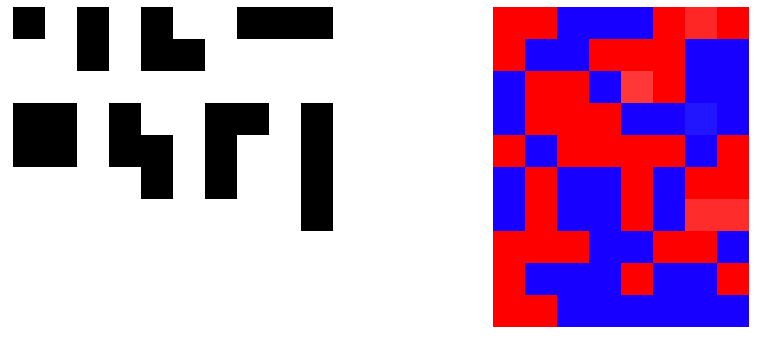
So, can I come up with a puzzle where the satisfaction comes from taking something disordered or messy and the pleasure is in making it neat? What if there was a grid with a mishmash of colours and you could carve out sections of it with (say) tetris pieces to make all the colour areas contiguous? Each turn you take one tetris piece, cookie-cutter out the piece from the existing grid, and move that piece to an open area. Repeat until all colours are contiguous areas. There could be a canonical solve using a fixed set of tetris pieces – in fact, this would be a reasonably easy puzzle to create just by starting with contiguous areas and reversing the process.

Activity Idea #2

I missed typing this up yesterday. I was thinking about ways of making it easier to manage my solo board games – I tend to leave something on the table and come and go. With some games it’s easy to leave in place and know where I’m up to because game state is tracked on the board, but with other games – such as Elder Scrolls – I have to do more rememberating.

So the idea is this: for each game, I make a sheet that lists of the phases of the game where it makes sense to pause, and keeps track of all the state that requires some sort of memory. In Elder Scrolls there’s the battle phase where I could indicate which character was currently active and whether they had done their move, explore, first action, etc. And there’s the travel phase where I could indicate what part of the turn I’m in – am I resolving an encounter, am I working out what reward to get, etc.

This only works if it’s really low friction; a laminated A4 sheet with spaces for counters or markers – actually, bluetacking it to the wall and using whiteboard markers is probably the go. In fact for the travel phase each travel section is divided into 12 days so I could just do a grid and fill it in as I do each one.

Likewise in the battle there’s a counter that goes up in the same way, so I could have a similar grid (marking the sixth turn onwards as fatigue turns).

App Idea #2

Okay, this is a little silly. I like to whistle and I know Siri exists, but I’d love to be able to control my phone by whistling. Just a simple app that turns whistling sequences into arbitrary commands would be lovely. I’ve always thought it’d be good in combination with a flashcard app so that while driving I could whistle for the next flashcard (generally an audio flashcard when I’m doing language learning, for example), and whistle to indicate whether I got the answer correct or not.

So I was wondering what else I could use whistling for, and I thought it might be fun as a morse code teaching tool – you hear a letter or word and you have to whistle out the morse code for it.

Song Idea #2

Okay, my challenge to myself: make a Spit song that isn’t self-referential, something more sincerely strange.

Rather than do a single idea, I figure I’ll do some brainstorming here – my first idea here is derivative but let’s use it as a jump off point

A song about a turn in an imaginary card game where the lyrics relate the increasingly bizarre actions (been done many times, of course – ProZD & other internet skits, Adventure Time, Parks & Recs, etc.)

A song relating the inventory of a lost & found shop. Some items are clearly related, and tell a story a la “one pair baby shoes, never worn”

A song about all the kind things you can do in a day, and how they got you arrested on suspicion of terrorism

A song that’s designed as a chant for footballers who happily accept that they’ve lost and congratulate the opposing team on their excellent plays and their supporters for being so polite and well mannered

A song relating the epic journey of a sock as it escapes the washing machine and finds freedom in the land of infinite socks, but sadly causes a black hole by being one sock too many

A love song between two butt cheeks

A song of revenge as a candle seeks out the man who set its head on fire, and joins forces with all the other things that the man has set on fire.

An AI generated song but it’s actually human generated because we’re cheaper.

Story Idea #2

Once when you were on holidays, you saw another tourist who you forgot almost instantly, but who remembered you for the rest of their life.

It wasn’t anything you did, not really – a coincidence of light and position, mood giving you form and your summer clothes telling everything of your life. Though the tourist said nothing, that moment captured you so perfectly they felt they instantly knew you. They suppressed an instinct to wave or nod, and turned away, but turned back again almost immediately doubting themselves. You noticed this double take and looked back at them, curious, but they looked away again. That was the entirity of your interaction.

Over the subsequent days they realised that this moment had been a confluence, the collision of two waves in the ocean. They were in the precise mind state to perceive you and you were in the precise state to be so perceived. They understood then how love at first sight was possible and regretted not talking to you. Haunted by curiosity but paralysed by propriety they waited too long to have even a chance to reconnect, and returned to their country where they never talked to anyone of this realisation, and had regular dreams in which they talked with you and told you of their life.

Board Game Idea #2

I’ve been working on a card game for many many years, inspired by a Scientific American article that I read in my teens about a game called “Undercut”, which doesn’t even show up in google now as there have been subsequent unrelated games called Undercut.

Regardless, last year I was working on it a bit more and I came up with an interesting theme for it – that it’s a game about the piano duels of 1800 between Beethoven and Steibelt. Each round you each secretly choose a card that has a theme and reveal them. If you correctly predicted the theme they pick, you are able to improvise around that theme and impress the audience.

So today’s idea is an aspect of this dueling game, where I try to lean harder into the new theme. Currently you each simultaneously choose a card, and how well you respond to the theme is based on how well you predict. But in a game about improvisation you should also be able to use the cards in your hand to put together a sequence that can recover from a shaky start.

Currently you have a hand of five cards and a layout of five cards on the board in front of you – every turn you play a new card and recover your oldest card. So this new mechanic allows you to go temporarily shorter on cards by playing additional cards on top of the initial choice. When you recover the original card you also recover the cards you laid on top.

I want to capture the feeling of improvisation, so the themes the opponent plays have to be varied enough that you can’t just plan around them. This isn’t a fully formed idea but there are two aspects to the themes currently: the number of notes (between one and five), and the type of notes – the length, where they are on the scale, etc. Currently the latter is unused; the only important part of the game is the number of notes. What if the “improvisation” bit involves the latter; trying to use your cards to construct a sequence that matches the type of notes played by the opponent?

Computer Game #2

I dreamed this one up this morning as I was waking up. So, you have a bunch of tetris pieces including the one square, the two square, and the two three squares. You have a 2d vertical grid, like bejeweled, but with fewer colours so there are reasonably large contiguous areas. Then on your turn you have to use as many of your tetris pieces as possible onto one of the colours on the grid. When you’re done, those pieces disappear, the rest fall down, and the remaining space is filled with random pieces.

It’s the kind of thing I’d code up first to see if that basic loop is engaging before properly gamifying it (putting a timer on, or eliminating pieces if they don’t get used within a time limit, or even just making it a more pure puzzle to be solved with no refilling of the grid). But it seems like fun!

Puzzle Idea #2

I was thinking about the kinds of puzzles I’ve never tried creating before, and I don’t know if I’ve ever actually made a jigsaw that had puzzle elements to it. So here’s the idea. It’s a jigsaw on one side and minesweeper on the other side. The jigsaw pieces all fit each other – it’s a generic jigsaw with no uniqueness to tell you that you got the fit right – but the picture is still a normal picture. You can flip each piece over and it’ll help confirm whether you got things right – the backs have numbers or colours on them and there are rules about what can be next to what. You can logically solve the whole puzzle upside-down and then flip it over for the picture, or vice versa and confirm the puzzle, or you can do a bit of both.

The idea is a bit like how cryptic crosswords have both the definition and the cryptic clue that hint to the same answer. With the jigsaw the pieces are generic but the picture and the puzzle hint to the same answer.

Activity Idea #1

I actually have no idea what to do with the Activity idea; I just needed a seventh category. Which is where brainstorming comes in! A lot of the types of activities I enjoy tend to be from the other categories, but what if I used this time/space to examine some of the ways I do things and see if there are ways they can be improved?

It could be either making a process I do more efficient or removing friction from something that has an annoyance. It could be adding variety to something I do often. As I’m enthusiasm-driven, making something I do more enticing could make it more doable.

There are a few things I really procrastinate on. First is video editing – I haven’t posted something to Valorant for Dinosaurs in over a year, but the script is written and I keep opening FinalCut Pro and doing tiny bits of tinkering. It would be good to have something that makes it more appealing. I know reward systems don’t work for me, and deadline systems are fine when I “believe” the deadline, but I currently don’t. So is there something that I’m excited to do in my video editing?

I am a little reluctant to make more work for myself because “fear of something I haven’t done before” is also a source of procrastination. Another thing I could do is reduce the quality – make a rough cut that has *something* there, and it won’t be a disaster if it’s released. Then the appealing bit would be adding cool stuff. I’ve noticed in other people’s Valorant content that they sometimes slap on gameplay footage that’s only peripherally related to what they’re talking about, just to avoid showing a blank slide. So perhaps I do that, or start a custom game with two players, hit play, and just record for the entire duration.