App Idea #1

I’ve been sporadically working on an App called “NumberLogger”, which lets you log numbers quickly.

Say for example you’re recording your weight daily. I used to open google sheets on my phone, go to the correct sheet, insert a row at the top, tap on the first element, and enter the number and the date. It took a while to do and had some fiddly actions as part of it, but it did let me record in a way that could show me a graph.

In my app, when it opens you see a keypad on screen and the last couple of entries. You can tap on an entry to fill the current entry with the same number, you can type the number, and you can use “+” and “-” to modify the number (by the last significant digit).

So my app idea is a part of NumberLogger. There are some things that you want to log for a particular day and you don’t care about the time of day that you log them. So I’m going to add a configurable parameter for the time-span resolution. It can be set to a number and a unit – so, second/minute/hour/day/week/month/year, and the number is the count of that unit.

With resolution set to 2 weeks, any number you enter in that two week period will still be recorded, but will be treated as a single number for the purposes of graphing. And when graphing you can specify the start of each time period.

For my daily weight recordings I always weigh myself at the same time but don’t record the value until later. The weight recording is intended to cover a particular day; the hour/minute/second aren’t important and shouldn’t contribute to the graph.
Song Idea #1

I’ve been working on a series of helpful songs for the new Spit album, so today’s idea will be something along those lines. I like the idea of memorisation songs – there’s a cool one for the first hundred digits of pi, and “Why does the sun shine” is a classic. So what if there was a song that helped you memorise something absolutely useless – say, the history of a made-up country? The kind of song that they make you learn and sing in primary school that’s kind of adjacent to the national anthem in the same way as Waltzing Matilda.

So the song “Drown, drown, drown Dr Hopdripper in 26 possits of goat cheese” is about the overthrow of the unpopular Molbanian religious reformer Dr Hopdripper in 1891, and the events leading to his death that involve several prominant people “accidentally” drowning in barrels of goat cheese as a kind of Putinesque threat.

The song itself should incorporate precise dates and times of the crucial incidents just so that when you sing it you can be extremely precise in how much useless information you have now stored in your head.

Story Idea #1

The boy stood on one leg, watching the dog in the forest. The dog studied the boy in return, shifting slowly from side on the soft wet leaves, the boy’s shoe in her mouth. The boy was breathing heavily, leaning on the husk of a tree, his shoeless foot covered in mud. He looked down and wiped his sole again, ignoring the dog and pretending to search for a thorn.

The dog knew the boy was not really hurt because he was not shouting at her. If he really had a thorn the game would be at an end and the dog would be in biiiiiiig trouble for sure. The boy was just waiting for her to get close enough to snatch the shoe out of her mouth. But the game was also not fun unless it was close and as long as the boy was pretending to be lame it would be boring. So she took a step closer and shook the shoe by the heel, then innocently dropped it in front of her. There was a clink as the shoe tipped over and a few yellow coins rolled out, shiny against the mud.

The boy remained quiet and focused on his heel. He wobbled slightly as he lifted it into a beam of the dying afternoon light. The shoe and its contents were utterly unimportant to him which was funny because she had seen just how important they had been when he had found the rusty metal box embraced in the roots of the fallen tree at the top of the hill.

Board Game Idea #1

As I do this “idea a day” challenge I’m working out the parameters of the challenge for myself. For example: can I use an idea I didn’t explicitly think of *today*? Can I use an idea that’s a development of an existing game or does it have to be a completely new idea?

And the answer of course is “whatever I want and is useful or fun”. So today’s idea is a brand new thing, EMUCOW, a roll & write boardgame about building hybrid creatures and placing them into your island. You generate animals by rolling 4 dice. Two are used to generate a random animal, and the sum of the other two are used to choose where to put the animal. You get points for each animal at the end of the game.

There are 4 sets of 6 animals you use to make up the hybrids. When you use an animal you cross it off:

FIELD: DOE COW YAK EWE GNU ELK

FOREST: CAT DOG RAT FOX PIG APE

RIVER: COD GAR EEL KOI BOA ANT

CAVE: OWL BAT EMU HEN BEE BUG

and you have 10 rounds in the game to place animals in a Settlers of Catan style island map, each hex having a number between 2 and 12. Each hybrid animal gets attributes from each category that they are in, and the habitats on the map give points for placing animals with certain attributes in them, and animals want other types of animals adjacent to them for maximum points.

Computer Game Idea #1

I do not understand how WordPress works any more and it is honestly very distracting, so today’s idea may be a little Annoyed With Dumb Things That Used to Be Simple and Are Now Needlessly Complicated.

So, my idea is for a game called Enshittification, after the Cory Doctorow term for the way the internet becomes gradually less and less useable.

The game is a series of levels, each looking like a control flow graph which you have to connect together with control arrows to make the system work in the desired fashion. It goes through the usual tutorials of simple level design with boxes representing “users” and “services” etc.

Gradually the levels become more and more “dark patterns” of detecting and exploiting weaknesses in human psyche. Before you know it, you’re dividing your users into different psychegraphics so that you can maximally exploit the whales while using other users as bait.

As cynical as this is (and I doubt the enshittification name and theme would survive to a final product) I am intrigued by the possibility of making a game where you have to make UML graphs. Could that be fun?

Happy New Year!

I enjoy the occasional New Year’s Resolution, and this year I have a couple.

  1. No buying board games this year. Instead I will play the ones I already have. Last year I set myself a modest board game budget which kept things reasonable, but I already have many excellent games now, and I found myself more and more asking “would I rather play this new cool looking game than one of my favorite games I don’t get to the table enough?”
    So this year I will put some dedicated play time into my favorite 20 solo games:

    It’s a Wonderful World
    Mage Knight Board Game
    Voidfall
    Cloudspire
    Dorfromantik: The Board Game
    Endeavor: Deep Sea
    Worldbreakers: Advent of the Khanate
    Jump Drive
    Unstoppable
    Lost Ruins of Arnak
    The Castles of Burgundy
    Nusfjord
    Sleeping Gods
    Terraforming Mars
    Wondrous Creatures
    Roll Player
    Underwater Cities
    Baseball Highlights: 2045
    The Guild of Merchant Explorers
    Mechs vs. Minions
    Factory Funner
    A Feast for Odin
    Black Forest
    Fang & Flame
    Blackout: Hong Kong
    Project L
  2. Keep going with my stretching and calisthenics, reducing the amount/difficulty enough so that I can easily do three sets of each exercise each weekday. Last year I found myself procrastinating on calisthenics especially; as long as I reduce the barrier to getting started (as I did with jogging) it should be possible to keep it up this year.
  3. Come up with and write down one idea each day of the year. I thought I might try dividing the ideas into categories – puzzles, computer games, board games, stories, songs, apps, and activities. Each day of the week I’ll do one of the categories to keep it varied.

Puzzle Idea #1

With that in mind, today’s idea is in the field of puzzles. I’ve always been intrigued by the idea of fonts where the glyphs can be read as different letters depending on the direction you are reading them. In the past I’ve tried designing crosswords where all the clues are written as horizontal words, such that when you do vertical words you just turn the crossword sideways. I designed a blocky SVG font that had some letters that could be parsed sideways (o -> o, t -> t, l -> r, H -> I, e -> m/w, z -> n, c -> u, etc.) but the intersection rules made it difficult to actually design a “proper” crossword that worked.

So, what if I go simpler and use the font to do a “Strands” kind of puzzle instead? I could require that the letters at the bend are parseable as sideways letters. The puzzle would look odd for sure with letters in all kinds of directions. But it seems cool.

Undercut

There’s an ancient game that I learned when I was a boy in the 1980s called Undercut – I’m pretty sure I learned it from Martin Gardner, Douglas Hofstadter or A.K. Dewdney in their Scientific American column. It’s a little like rock-scissors-paper but with numbers from 1 to 5 instead.

You simultaneously chose a number between 1 and 5, and the larger number wins a number of points equal to the difference. There’s a catch, though: if you choose a number exactly one less you win instead, and you win the sum of the numbers. So for example, if you choose 5 and I choose 2, you get 3 points; but if you choose 5 and I choose 4 (and thus Undercut you) I get 9 points.

I’ve always loved Undercut, and for years I’ve mulled making my own version, something that takes the basic mechanic and applies it to another medium – eg. a card game. A few years ago my daughter Clara and I designed a card game version that had some neat mechanical additions to the basic Undercut formula, but I never got around to making a prototype, until now.

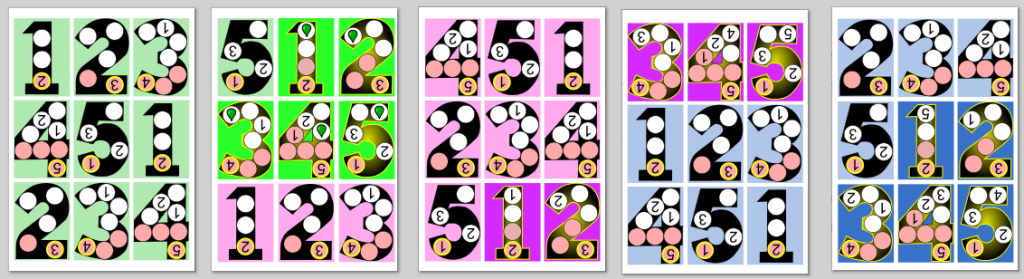
Each colour is two sets of 1-5 and a bonus third set that you unlock when you get undercut.

The game is two players – you each lay out 5 random cards from your starting 10, and start with 20 life tokens. You win a game by running the opponent out of their life tokens.

In each round you simultaneously play a card, then pick up the “oldest” of the 5 you have down. If the number you played is represented on the opponent’s card (the upside-down small numbers) you pay life tokens by putting them on that card to fill it up to that point – so if you played a 3 and I played a 4, I’d put 7 tokens down on the “3” card. Tokens on red spots are lost until the next game, but tokens on white spaces get returned to you when the card is picked up – you recover health over time (if you can hold out).

I gave it a playtest last week and got some wonderful feedback, which I’m rather excited about implementing.

Voidfall

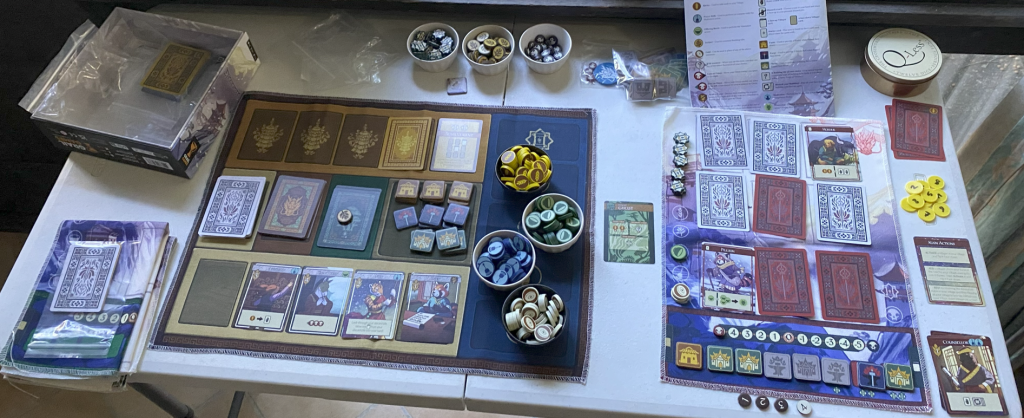
I enjoy playing solo board games, and I’ve come across a particularly nice one that I’ve had on the table for almost a month. Voidfall is a monster of a game, the kind of crazily busy Euro with four pages of icons and multiple rulebooks with a supremely inelegant tutorial scenario that is intended to ease you into the game. I see the point, but it’s almost a part-time job to sort out the “rules to ignore for the tutorial” from the “rules for solo play”. The game is nuts, but I knew that going in.

What’s great about it is just how much agency you have in the game, and how much you get to do. There are resources, oh so many resources, and bonus actions and combos, and you can plan out your turn weeks in advance and if you feel like saying “screw it, we charge” it’ll often work out because there isn’t much randomness and there are so many options. It took me weeks to get through the very first scenario and the brain burn was delicious. Thoroughly recommended but my goodness, watch a video of it being played first to see if it’s the kind of thing you like. The cost is heavy; the reward is sweet.

Matthew Dunstan’s Game Design Videos

I’ve been really impressed with the insight in Matthew Dunstan’s series of videos on game design.
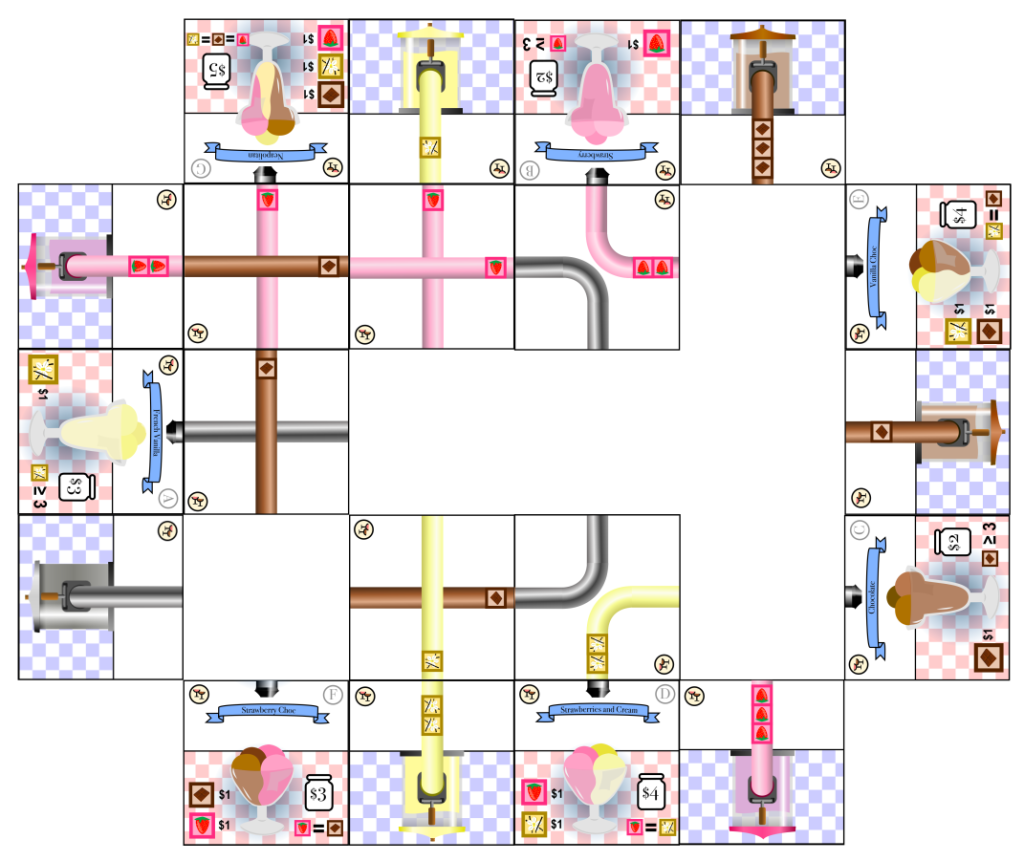
Obviously he really knows his stuff as he’s a published game author (including one of my favorites, Guild of Merchant Explorers) but he can also articulate his thoughts into advice that you can actually do something about. Right at the beginning of the above video he talks about games that start from a good mechanic but then struggle to turn into a compelling game, and recommends melding a theme early on in the process. This is exactly how Neapolitan came to life – it was meandering along as a cool mechanic for a while, but the addition of the ice cream shop theme pushed it into focus. It helped make the scoring and win conditions work, which meant the goals were understandable, which reduced the cognitive load on player turns.

One thing I love about mechanic + theme synergy is that it’s one of those spaces where combinatorial glue innovation can result in something quite unique, and the idea space is incredible. When the mechanic + theme mesh well it feels like you’re not inventing something, you’re merely the person with the privilige of discovering it.

Playtesting Neapolitan

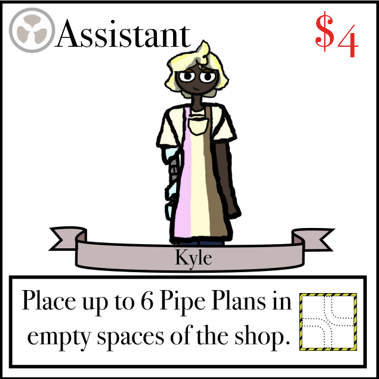
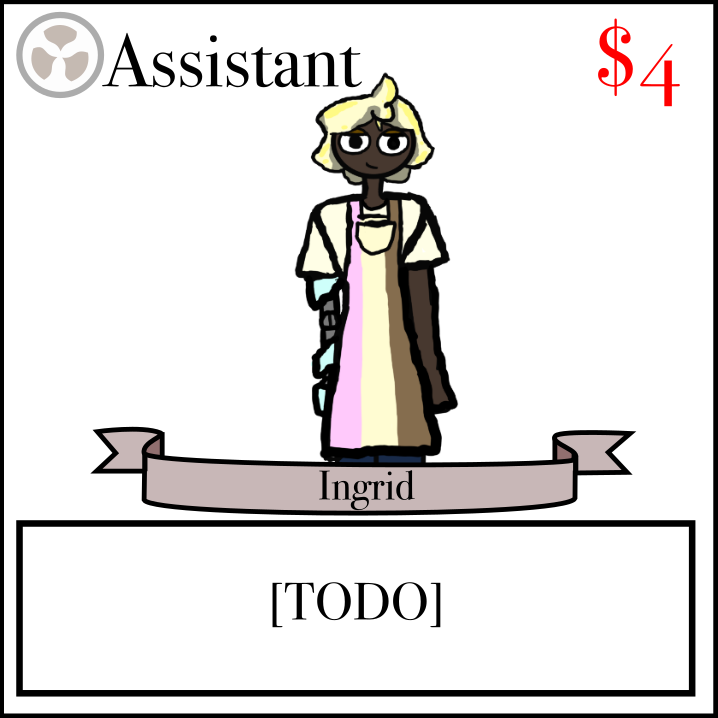
I’ve been doing a lot of playtesting for Neapolitan, adding scenarios and testing new Assistants. After PlayCon I quickly added the third scenario and Clara illustrated a new assistant for me, and I immediately knew what abilities I was going to give the assistant because I’ve been cheating in my playtesting for months now.

In Neapolitan there’s a moment in the mid-game where some of the more obvious pipes are laid down and you need to start thinking about how to place your remaining pipes so that all the customers get the right ingredients.

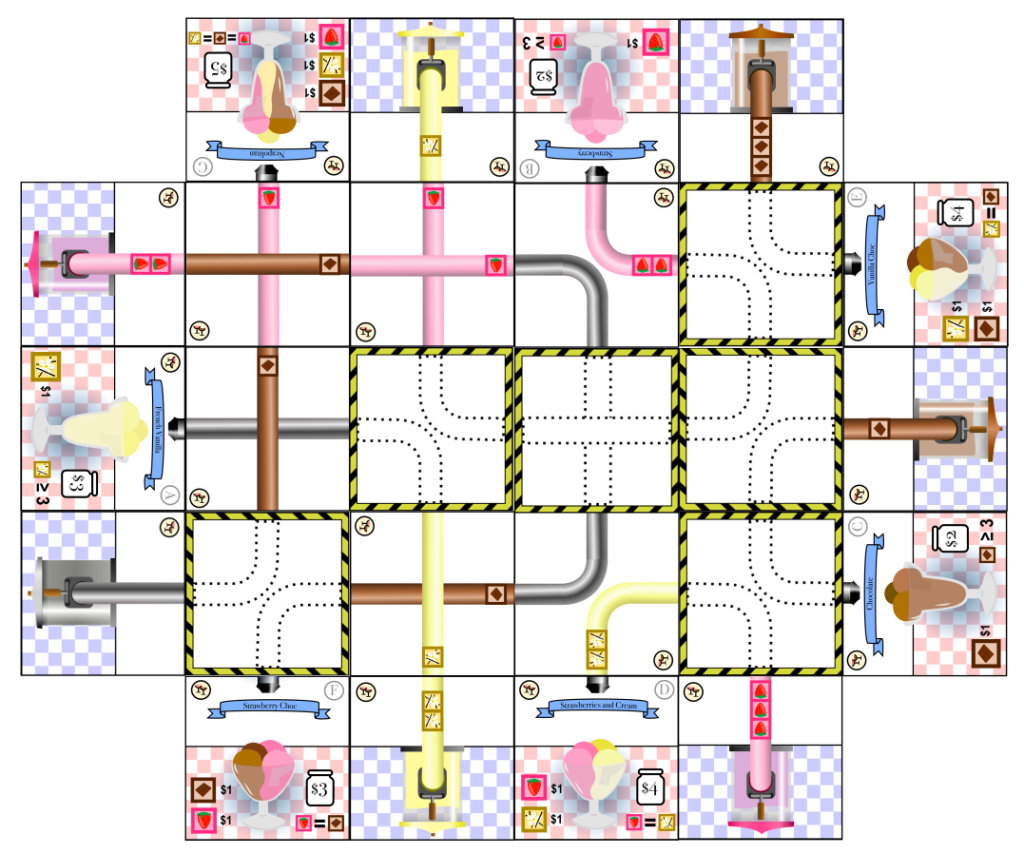
It really helps to lay out “temporary” cards showing bends or straight pipes to work out which pipes should go where, and what options you have. I’ve always used the backs of random old cards and drawn dotted lines on them to work out what’s possible and what’s not. And when I playtested, I always treated it like this was a $4 assistant.

With my third assistant I’ve finally made that official.

This lets me plot out my next moves, revealing that I’ve already messed up the Strawberry customer, but the Neapolitan, Strawberries&Cream, and Strawberry Choc customers are still a possibility for getting a tip.

The thing I’m wondering most now is: should this assistant be available from the very first scenario? My worry is that it’s the kind of thing where you have to have played a little bit before you become aware of the “mid-game crisis”. I’d rather introduce it when the players most appreciate it.

This website & Neapolitan

Part of the reason for this sudden revival in blogging (I used to have a blog on the now-defunct otherleg.com which I updated for many years) is that youtube doesn’t allow you to update videos.

And fair enough! If you could update a video you could rickroll people every day. But it is an annoyance for me when I want to post a video for the rules to my card game Neapolitan, because if I point people to the video, what happens when I need to update the rules?

The obvious thing to do is have an intermediary – say, a web page that can point to the rules video and/or rulebook. Then I can update each as I need to and still have a QR code that I can include on a business card etc.

So in a sudden burst of enthusiasm (I have come to understand that this is one of the perks of ADHD) on the night before PlayCon, I registered andrewshellshear.com, make a wordpress website, made a quick page for Neapolitan, made a QR code that pointed to it, and made a bunch of business cards that had the QR code.

So the website is still pretty rough. Hopefully my enthusiasm carries me far enough to do some better styling on the pages, it looks kinda ghastly at the moment.

Snowcrest

Played my first two solo games of Snowcrest after picking it up from Play Con on the weekend, and what a delightful half-hour solo game this is.

There are minimal differences between the solo and multiplayer experience, graded difficulty levels, and in half an hour I built two very different engines in my two playthroughs – the first focused on gold; the second on buildings.

It’s a tableau-builder game, secretly a worker placement where the workers are cards. Quick to learn, nicely thinky, definitely a keeper for me due to the quick play time. Like Jump Drive I feel like this is going to be one of those palate-cleansers that I play far more than the chunkier games.

So far the difficulty has been a little easy, so I’ve bumped it up to difficulty 9 for my next playthrough, and I’m looking forward to this one! I’ve already got the Monk out who has recouped some of the hefty cost, no sign of the gold miner so looks like it’s a new strategy lads…