
There's an ancient game that I learned when I was a boy in the 1980s called Undercut - I'm pretty sure I learned it from Martin Gardner, Douglas Hofstadter or A.K. Dewdney in their Scientific American column. It's a little like rock-scissors-paper but with numbers from 1 to 5 instead.
You simultaneously chose a number between 1 and 5, and the larger number wins a number of points equal to the difference. There's a catch, though: if you choose a number exactly one less you win instead, and you win the sum of the numbers. So for example, if you choose 5 and I choose 2, you get 3 points; but if you choose 5 and I choose 4 (and thus Undercut you) I get 9 points.
I've always loved Undercut, and for years I've mulled making my own version, something that takes the basic mechanic and applies it to another medium - eg. a card game. A few years ago my daughter Clara and I designed a card game version that had some neat mechanical additions to the basic Undercut formula, but I never got around to making a prototype, until now.
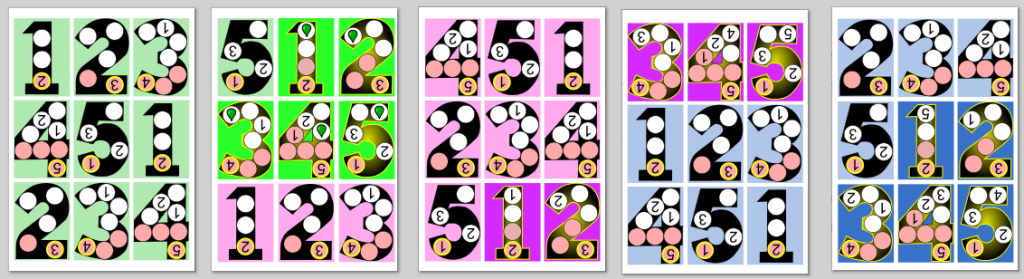
Each colour is two sets of 1-5 and a bonus third set that you unlock when you get undercut.
The game is two players - you each lay out 5 random cards from your starting 10, and start with 20 life tokens. You win a game by running the opponent out of their life tokens.
In each round you simultaneously play a card, then pick up the "oldest" of the 5 you have down. If the number you played is represented on the opponent's card (the upside-down small numbers) you pay life tokens by putting them on that card to fill it up to that point - so if you played a 3 and I played a 4, I'd put 7 tokens down on the "3" card. Tokens on red spots are lost until the next game, but tokens on white spaces get returned to you when the card is picked up - you recover health over time (if you can hold out).
I gave it a playtest last week and got some wonderful feedback, which I'm rather excited about implementing.